Staging the Unknown:
Directing an Opera Without a Tradition

Reflections on directing the first modern revival of Girolamo Abos’ Pelopida (1747)
Male opera performer in white costume stands alone among classical statues on a dark stage in Abos’ Pelopida, directed by Brett Nicholas Brown

To direct an opera with no performance history is to begin without inheritance. There are no traditions to resist, no expectations to subvert, no accumulated knowledge to refine. Nothing has settled into form. The work does not yet know what it is. This must be discovered through the process of making.

Such absence is often described as freedom. In practice, it produces something closer to exposure. Every decision, whether musical, visual, or dramatic, carries a different weight when there is no precedent to absorb it. There is no shared language between stage and audience. Meaning is not interpreted, but constructed.

In approaching the first modern revival of Girolamo Abos’ Pelopida (1747), reconstructed from manuscript sources, I found that the central task was not how to realise the opera, but how to allow it to exist at all. At first, the openness of the material and its possibilities created a sense of disorientation.

Over time, this uncertainty transformed. Working closely with the manuscript material, distance gave way to familiarity, and then to something more personal. The opera revealed a clarity of dramatic purpose that made it increasingly compelling to inhabit. What began as a challenge became an attachment: an act not only of construction, but of recognition.

Without an inherited framework, the director must establish one. Questions of dramaturgy, character, and relationships, and their intersection with the music, must be discovered through a process of study and making. The result must not feel arbitrary, but inevitable, as though it could not exist otherwise.

Two performers in contrasting white and red costumes move in a stylised duet before classical statues in Abos’ Pelopida, directed by Brett Nicholas Brown

In the case of Pelopida, this process began long before rehearsal. Over nearly a year, I worked with the libretto and score, allowing the opera to disclose its internal logic. Rather than imposing a concept, my aim was to listen: to understand how the music and drama move, how the characters emerge within them, and where their tensions lie.

Alongside this, I engaged with historical accounts of Pelopidas, the Theban statesman, encountering not a single fixed portrait, but a figure shaped through interpretation and memory.

The drama began to reveal itself as something loosely biographical in impulse, centred on a figure shaped through pressure: political, emotional, and relational. Within the conventions of opera seria, questions of duty, honour, and responsibility are tested, as characters are placed in situations that demand decision. Private feeling and public role come into conflict between father and son, lovers and friends, ruler and subjects.

I came to understand the opera as something held between times, neither fully recoverable as a historical ‘museum piece’ nor entirely translatable into a contemporary context. It resists both preservation and reinvention.

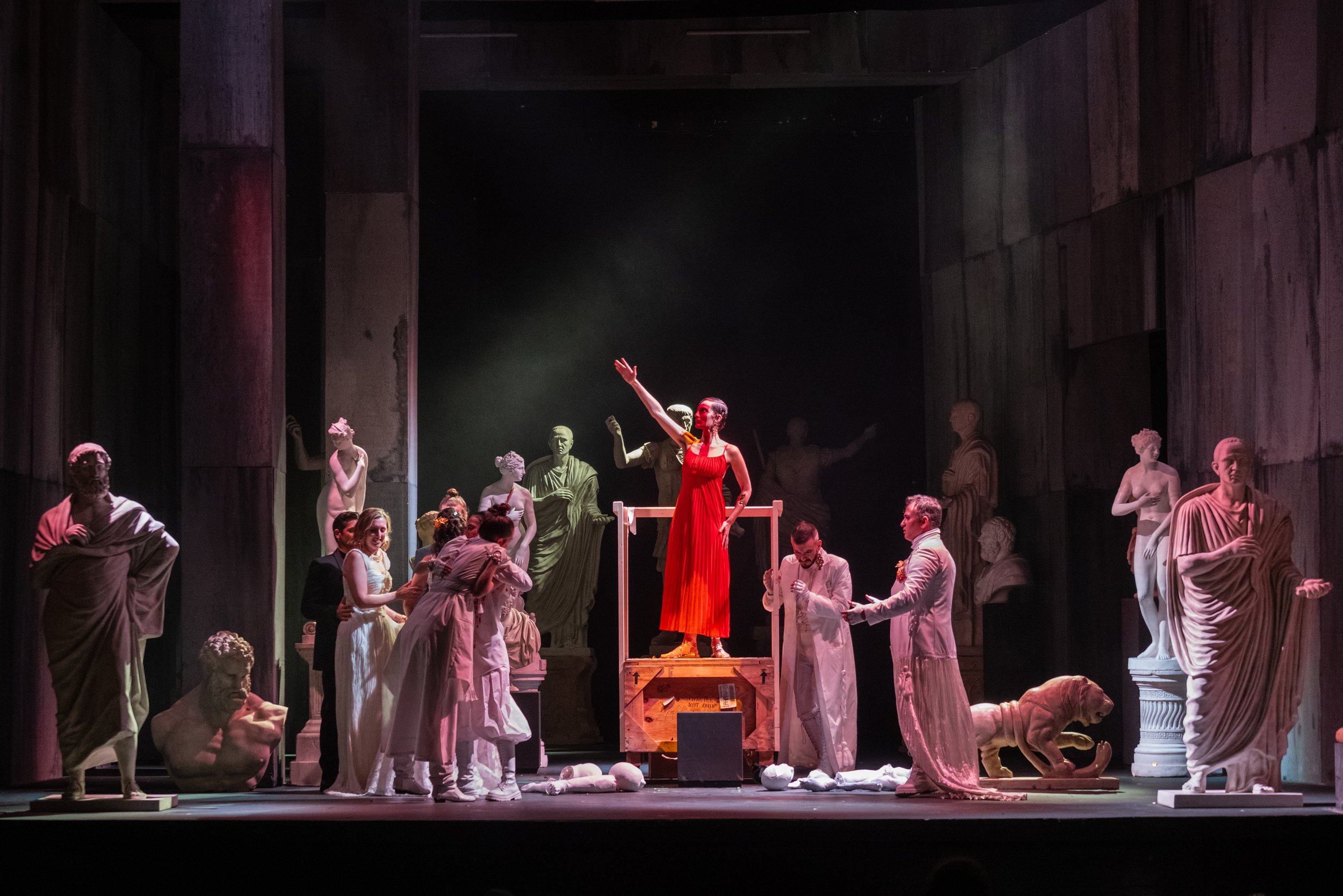
The concept of a museum then emerged in a different way: as a theatrical environment rather than a historical reference. Ancient Thebes became a sculpture museum: a space where fragments of the past are preserved, displayed, and reinterpreted. The characters move among the remains of earlier civilisations, negotiating their present within curated memory. The museum becomes both a site of preservation and construction, a space in which Theban identity is assembled from what survives and is protected.

Full ensemble scene from Abos’ Pelopida with performers arranged among classical statues around a central figure on stage

The articulation of this world depended on collaboration. The initial image of the museum did not arrive fully formed, but was developed through dialogue with the creative team, each bringing their own language and sensibility to the process. My role was to establish a framework within which these elements could evolve in relation to one another, ensuring that the visual, musical, and dramatic languages remained aligned. In this way, the production took shape as a shared realisation, grounded in a clear conceptual direction.

This process of preparation continued into the development of the staging itself. In the absence of an inherited framework, the opera had to be imagined in full before rehearsal began. This required a sustained act of visualisation, tracing the movement of the drama across the entire opera, anticipating relationships, spatial dynamics, and points of tension.

At the same time, the manuscript material demanded a process of reduction. The recitative, while central to the dramatic structure, often carried repetitions that diluted its immediacy for a contemporary audience. Shaping the work involved making cuts in advance, refining the text to clarify its progression without losing rhetorical force. Decisions around da capo structure were approached with similar care: in some instances, repetition arrested the dramatic momentum, while in others it allowed for a deepening of emotional state. These choices were made as part of the same process of construction, balancing fidelity to the material with the need for dramatic clarity.

By the time rehearsals began, the production existed as a complete working structure, ready to be shared, tested, and refined by the singers, supporting artists, musicians, and the creative team.

In the rehearsal room, the work began to reveal its true nature. What had been understood in study and constructed in preparation took on a deeper clarity when embodied, sung, and played. Certain assumptions were confirmed, others resisted. The material disclosed unexpected rhythms, tensions, and greater depth within relationships. The opera did not simply take shape; it began to assert its own logic in performance.

The singers were central collaborators in this process. Their expertise in eighteenth-century vocal practice brought a precision of phrasing, virtuosity, and rhetorical clarity that shaped the staging from within.

Female opera performer in white stands centre stage as surrounding figures reach toward her in Abos’ Pelopida

On stage, in the intimate space of the theatre, the visual language of the production emerged through a close alignment of elements. The set established a space of mass and permanence, evoking a landscape of fragments suspended between ruin and display. Costume drew on classical forms without resolving into a fixed period, allowing the characters to exist within the same temporal ambiguity as the world they inhabit.

Light articulated the boundary between object and presence, at times rendering bodies sculptural, at others returning them to motion and instability. Movement developed as a language of tension and suspension, in which bodies were treated as sculptural forms, shifting between object and presence, and where stillness carried as much weight as action. Together, these elements did not illustrate the concept, but extended it, allowing the museum to function as a lived environment rather than a visual metaphor.

Female opera performer in white stands among classical statues in a sculptural stage setting in Abos’ Pelopida

The musical and dramatic structure of the production was shaped through an ongoing collaboration with conductor Giulio Prandi, in which the relationship between the orchestra and stage was conceived as an active exchange rather than a fixed hierarchy. Together, we approached the score as something that had to function theatrically as well as musically, with structure, pacing, and dramatic pressure emerging through that dialogue. 

The Arianna Art Ensemble, performing on period instruments, contributed a sound world of immediacy and transparency, in which musical gesture and dramatic action remained in constant dialogue. Rather than accompanying the stage, the music acted upon it, sharpening contrasts, sustaining tension, and at times unfolding with a striking expressive clarity that brought the emotional structure of the opera into sharper focus.

In performance, the work completed itself. The presence of an audience altered the balance of the staging, sharpening its tensions and bringing its underlying structure into clearer focus. What had been constructed in rehearsal became something shared and alive. At this point, the opera no longer felt like something to be resolved, but something to be encountered.

To stage an opera without tradition is not to impose a fixed form, but to allow one to emerge through process, collaboration, and encounter.

The unknown is not a limitation, but a condition of possibility: a space in which the work can be discovered, and, in being discovered, made present. ■

Pelopida (1747) was directed by Brett Nicholas Brown, with design by Anthony Bonnici, costume by Luke Azzopardi, lighting by Moritz Zavan Stoeckle, choreography by Simon Riccardi-Zani, and performed by the Arianna Art Ensemble under the musical direction of Giulio Prandi. Presented by Festivals Malta as part of the Valletta Baroque Festival at Teatru Manoel, Malta. 

This essay forms part of an ongoing reflection on directing practice.