Time as Dramaturgy: Staging Gluck Across Two Worlds
Il Parnaso confuso & La corona at the Valletta Early Opera Festival
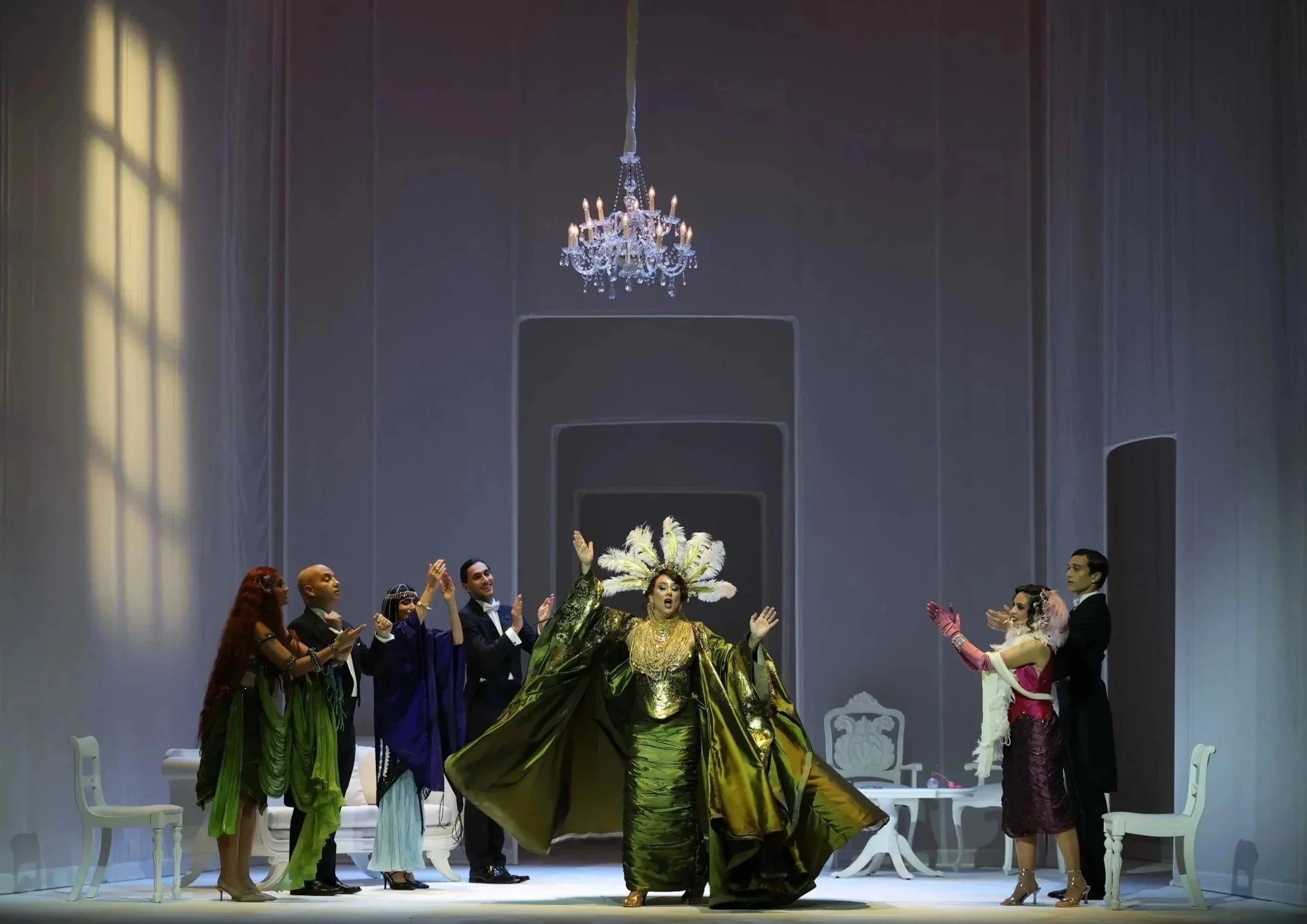
What does it mean to stage an opera that exists between worlds: between myth and social realism, between inherited form and contemporary understanding?
Christoph Willibald Gluck’s Il Parnaso confuso and La corona, composed separately in 1765 for the Habsburg court, occupy a curious position within his output. Shaped by the expectations of courtly entertainment, they sit at a point of tension between inherited operatic convention and the emerging clarity of Gluck’s reformist instinct. Their music already gestures toward a more direct, expressive language, while remaining shaped by the dramaturgical structures of Pietro Metastasio, and bound by their original context to a world of display, ceremony, and artifice.
In directing these works at the Valletta Early Opera Festival, the question was not how to modernise them, but how to reveal their internal logic. Although conceived independently, the two operas suggest an unexpected continuity: a movement from playful performance toward moral action. Rather than treating them as discrete works, I staged them as successive states of the same world, revealed through time.
Both works are written for four female voices. This concentration of female presence became a starting point for the staging. It prompted a broader consideration of historical moments in which women occupy a more visibly active or self-determined position, bringing their agency into alignment with the operas’ movement from performance toward action.
This led to the decision to relocate both operas within the setting of an English country manor across two distinct moments of the twentieth century.
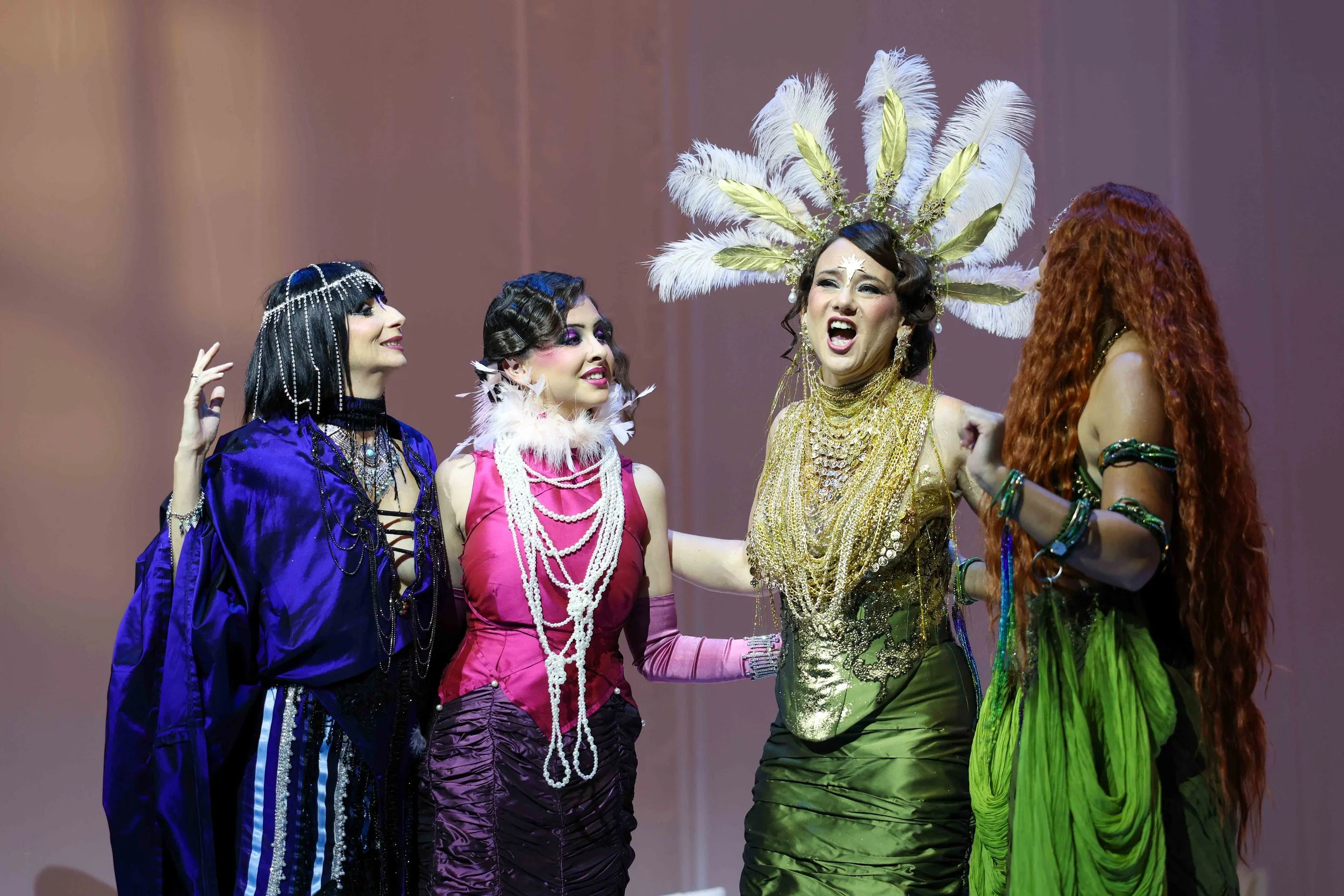
Il Parnaso confuso unfolds in the 1920s, within a culture of display, leisure, and aesthetic experimentation. Apollo and the Muses are depicted as decadent ladies of society. The drawing room becomes a site in which mythology and social ritual intersect: a space for performance, courtship, and stylised identity. The wedding at the centre of the opera finds a natural parallel in the social world of the period, while the figures of Apollo and the Muses emerge as participants in a culture defined by artifice, elegance, and play.
Each of the Muses was associated with a distinct aesthetic language drawn from the shifting fashions of the 1920s. Their identities were articulated through references to Salomania, the Egyptian Revival, and Japonisme, each embodying a different mode of stylisation and cultural projection. These visual codes function not as historical quotation, but as extensions of the opera’s theatricality: forms of self-presentation in which identity is constructed, performed, and displayed. In this way, costume becomes not merely decorative, but dramaturgical, reinforcing a world in which surface and performance are inseparable.
Here, myth does not stand apart from reality, but is absorbed into it. The characters operate simultaneously as social figures and mythological archetypes, allowing the opera’s shifting allegiances and playful contradictions to unfold within a recognisable human framework. The boundary between sincerity and performance remains deliberately unstable.
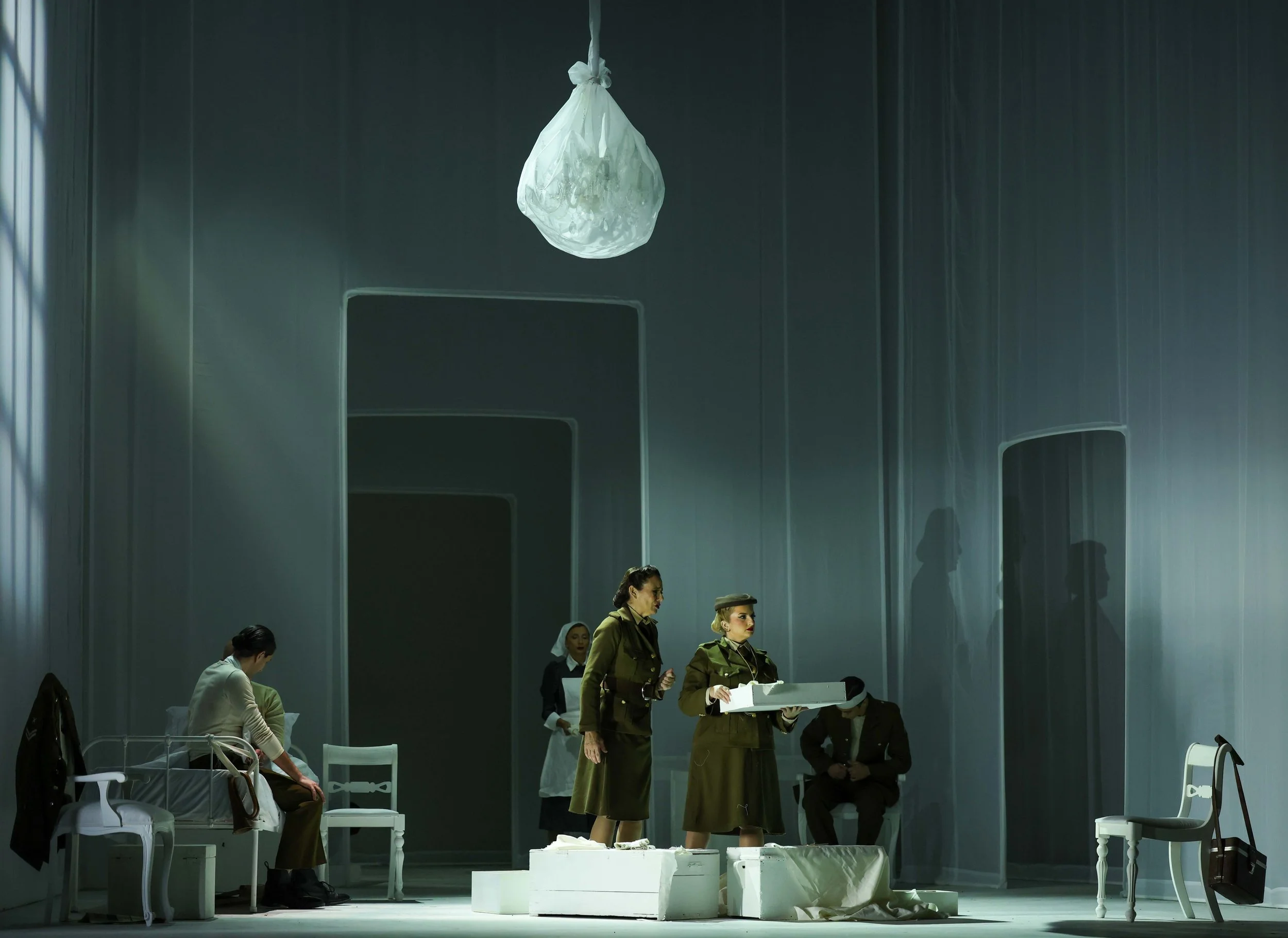
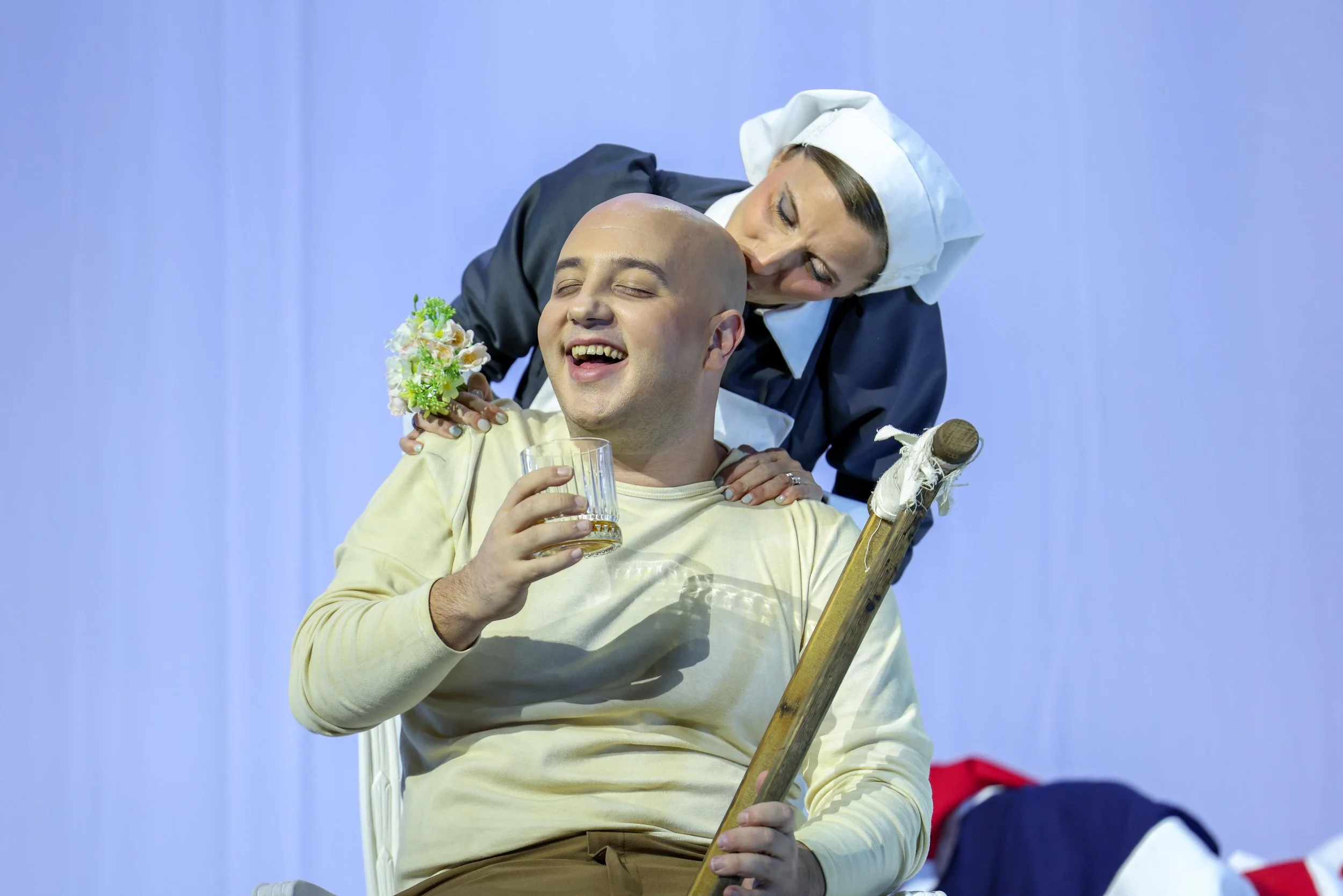
By contrast, La corona is situated in the 1940s, as the same manor is transformed by the pressures of war. The atmosphere of leisure is replaced by one of purpose, as the house becomes aligned with the structures of wartime service. Atalanta, Asteria, and Meleagra are positioned within the Auxiliary Territorial Service, while Climene is associated with the British Red Cross. The world is no longer organised around display, but around contribution.
In this context, the traditionally male role of Meleagro was reconceived as Meleagra, allowing the central relationship of the opera to be understood through a sapphic lens. Emerging from the social reality of the setting rather than being imposed upon it, this shift brings the emotional dynamics of the work into sharper focus and aligns the relationship between Atalanta and Meleagra with the opera’s broader movement toward clarity of action.
Atalanta, in this light, is defined not by romantic fulfilment but by her commitment to service. Her rejection of Meleagra’s declaration of love does not diminish the emotional force of the work, but intensifies it, allowing the opera to conclude in a state that remains open rather than resolved.
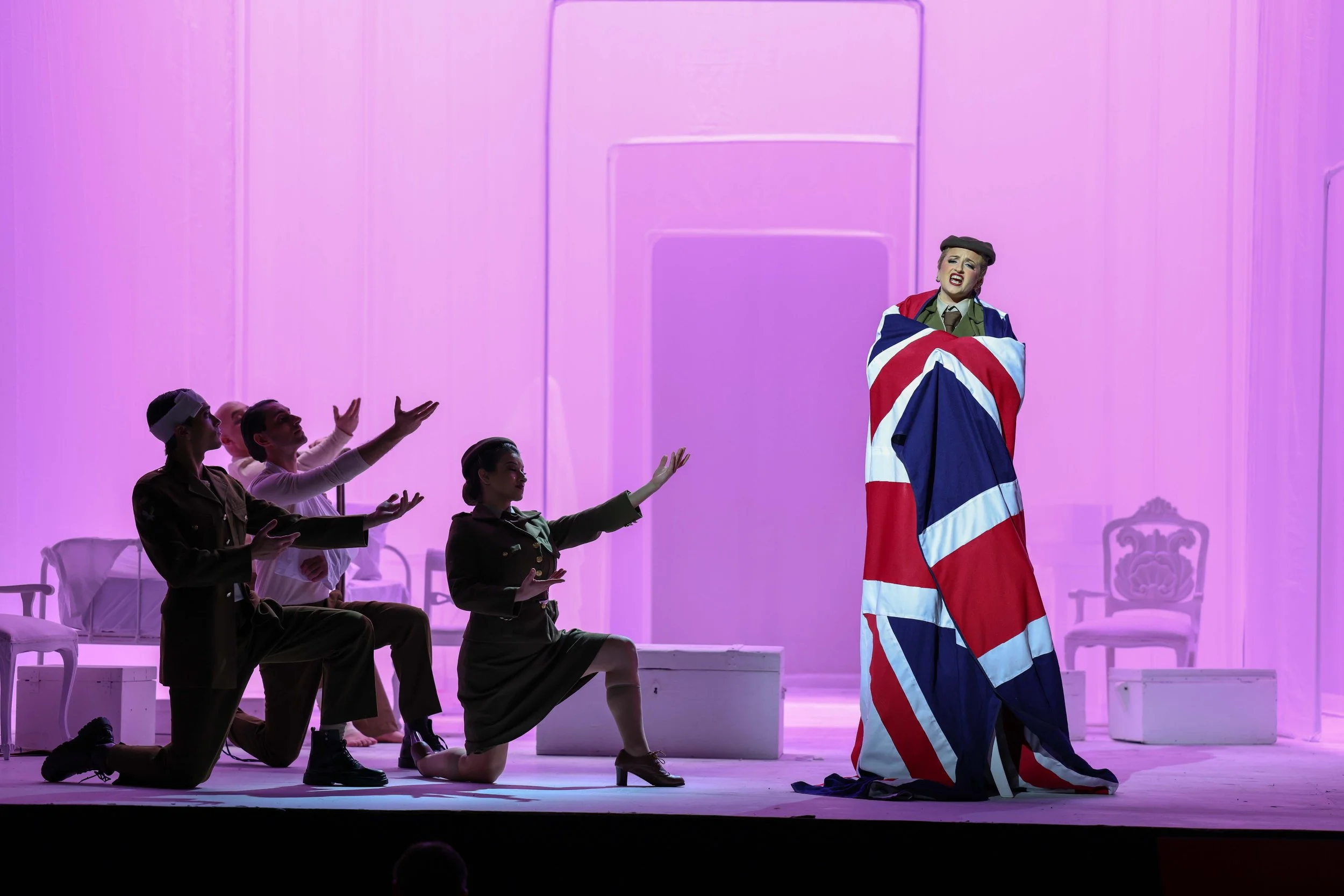
The mythological framework is correspondingly reoriented. The hunt for the Calydonian boar, rather than existing as a distant heroic narrative, resonates as a metaphor for collective struggle, refracted through the experience of the Second World War. The fusion of myth and social realism allows the stakes of the opera to be understood in immediate human terms.
The visual language of the production was conceived in close dialogue with the design team, with material functioning as an extension of the dramaturgy. The set, designed by Anthony Bonnici, remained constant across both operas: a country manor constructed from gauze-like fabric, its translucent walls revealing corridors and adjoining rooms beyond the central space. This permeability allowed the world to feel both contained and porous, with characters able to observe, enter, and withdraw from the action in a manner that reinforced the shifting boundary between public and private life.
Across this shared architectural framework, the costumes, designed by Luke Azzopardi, articulated the passage of time through their changing relationship to fabric. In Il Parnaso confuso, fabric appears in abundance: expressive, decorative, even excessive. The world is one of visual indulgence, in which material becomes an extension of performance itself, echoing the culture of display that defines the 1920s setting.
In La corona, this relationship is fundamentally altered. Fabric becomes functional, stripped of ornament and redirected toward utility. The presence of uniforms establishes a new visual order, while plain white cloth is repurposed within the action as bandages, torn and applied in response to injury. What had previously signified aesthetic pleasure is now reconfigured as a means of care and survival. This transformation of material mirrors the broader shift within the two operas, as a world of play gives way to one shaped by necessity and consequence.
This logic extends further to the use of a large Union Jack, which appeared not only as a marker of national identity, but as a mutable fabric within the action: guided by Atalanta, it shifts from entertaining the troops, to the imagery of Britannia, and finally to a celebratory tea tablecloth.
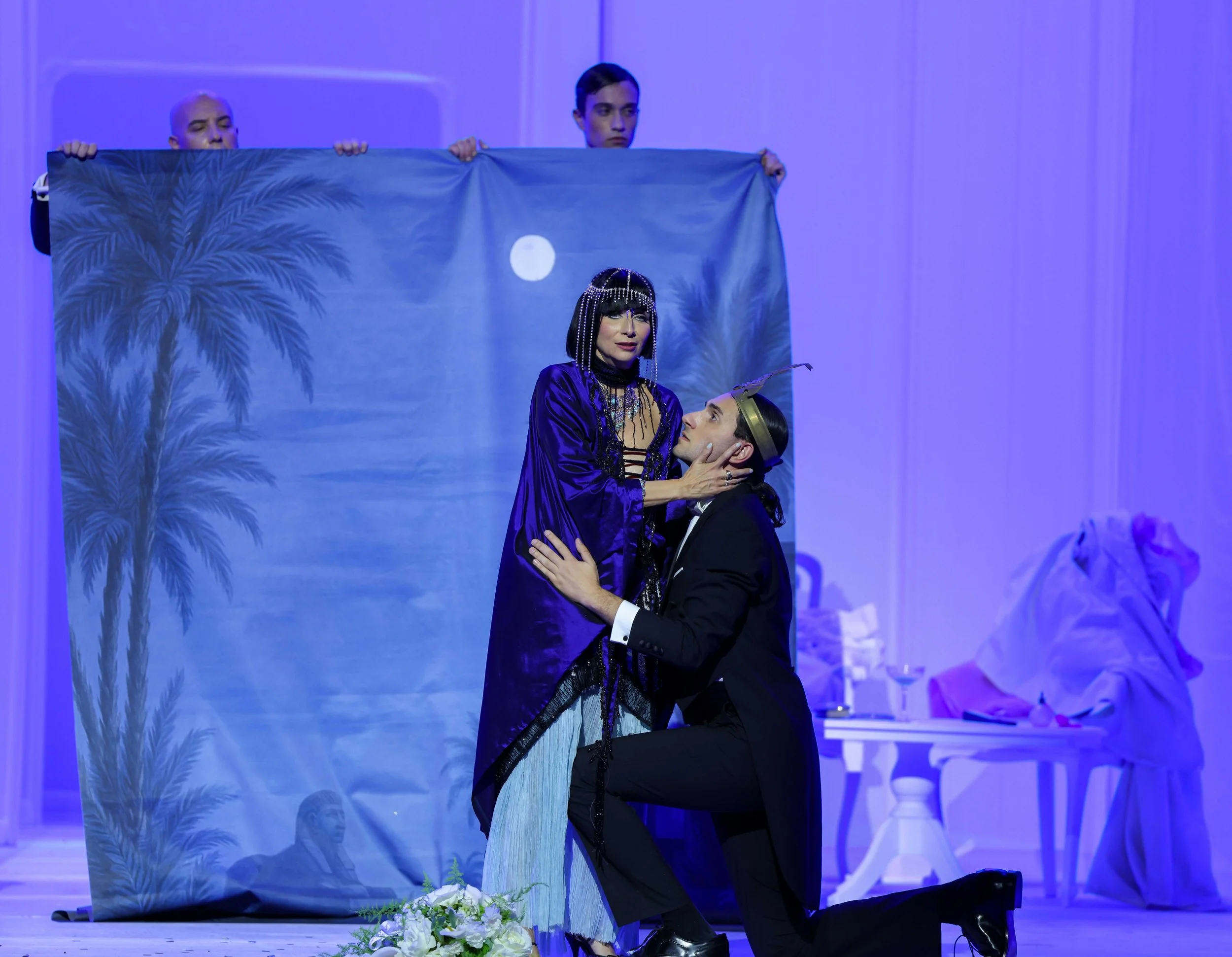
A further continuity between the two operas was established through the presence of three supporting male actors. In Il Parnaso confuso, they appeared as butlers within the drawing room, initially positioned at the periphery of the action. Gradually, they were drawn into the performative world of Apollo and the Muses, their roles shifting from observers to participants, and ultimately lovers. Their presence grounded the opera within a recognisable social structure, while also allowing the boundaries between service, performance, and desire to dissolve.
In La corona, these same figures returned, transformed by time, as wounded soldiers. The world that had once permitted play now bore its consequences. Where they had previously facilitated performance, they now carried its aftermath in their bodies. This continuity allowed the two operas to be understood not as separate entities, but as successive states of a single world, in which roles, identities, and physical presence are reshaped by the pressures of history.
From the outset, the production was shaped in close alignment with the musical direction of Giulio Prandi and Giacomo Biagi, and the playing of the Arianna Art Ensemble. Their approach to Gluck’s score was rooted in historically informed performance and responsive to the theatrical moment.This supported a reading in which clarity of expression takes precedence over ornament, allowing the dramatic shifts between the two operas to register with particular acuity.
In the intimate acoustic of Teatru Manoel, this relationship between music and action becomes especially direct. The proximity between ensemble, performers, and audience restores a sense of scale appropriate to the works’ original context, while also heightening their expressive impact. In this setting, the music does not accompany the staging, but exists in dialogue with it, each informing the other in the moment.
Time, in this production, operates not as a backdrop, but as a structuring force. The shift from the 1920s to the 1940s does not simply relocate the action, but reveals a latent trajectory within the works themselves, moving from display to decision, from artifice to consequence, and from performance to action. The intimate scale of Teatru Manoel further intensifies this progression, allowing these transformations to unfold in close proximity to the audience, where shifts in physical presence, material, and purpose can be directly perceived, whether in the movement of bodies or the transformation of fabric.
To stage these operas was not to impose a contemporary frame, but to trace a line through them, allowing time to act upon their world and make visible the clarity embedded within Gluck’s music and Metastasio’s dramaturgy. What emerges is not a reinvention, but a reorientation: a way of seeing these works as part of a continuum in which meaning is not fixed, but revealed through change. ■
Il Parnaso confuso & La corona (1765) was directed by Brett Nicholas Brown, with design by Anthony Bonnici, costume by Luke Azzopardi, lighting by Moritz Zavan Stoeckle, choreography by Simon Riccardi-Zani, and performed by the Arianna Art Ensemble under the musical direction of Giulio Prandi and Giacomo Biagi. Presented by Festivals Malta at the Valletta Early Opera Festival, Malta.
Production photographs: David Mallia / Festivals Malta.
This essay forms part of an ongoing reflection on directing practice.